How to Spot the Best Bitcoin Casino in Canada in 2026: A Buyer's Guide to Licensing, Fees, and Payout Speeds
How to Spot the Best Bitcoin Casino in Canada in 2026: A Buyer's Guide to Licensing, Fees, and Payout Speeds
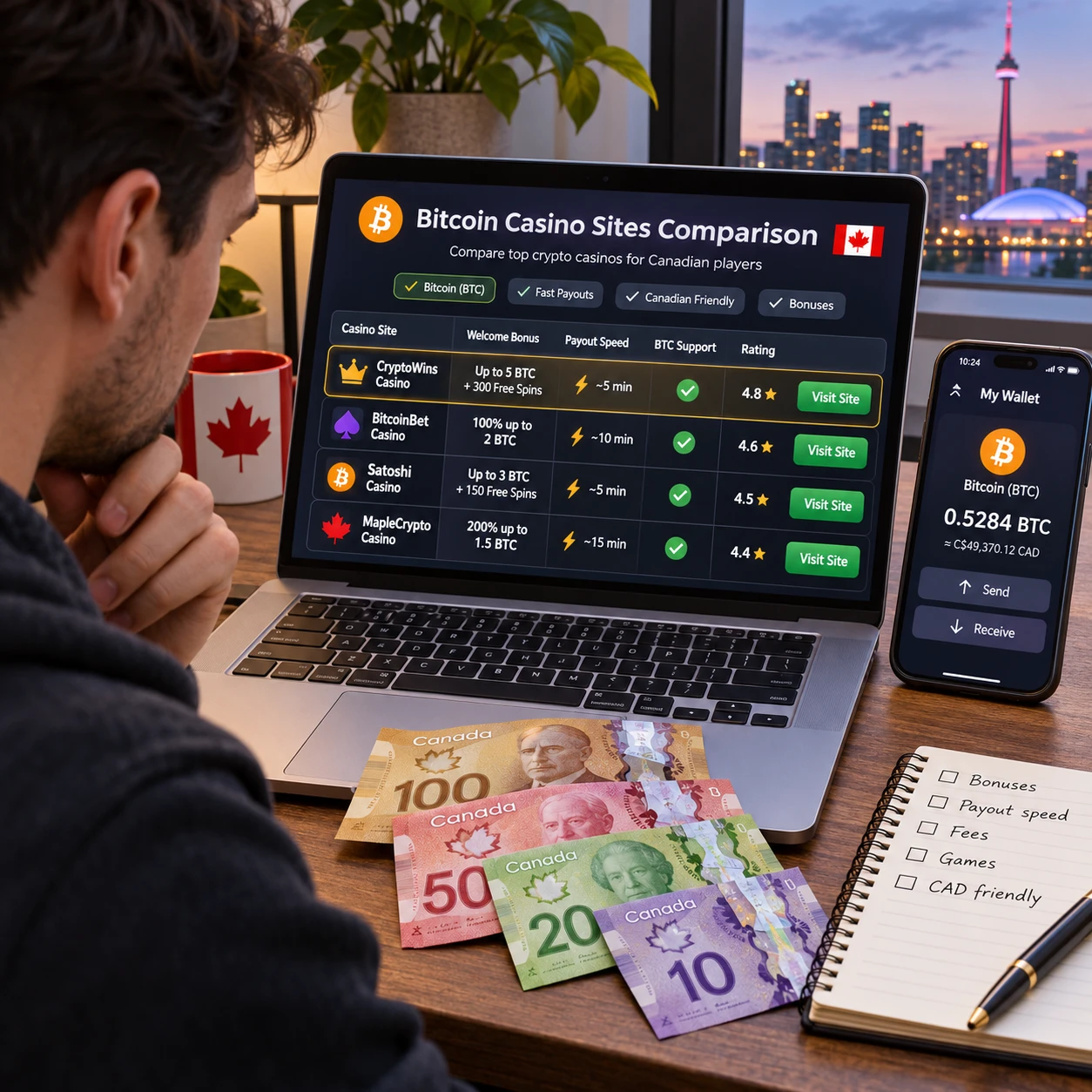
Bitcoin deposits stopped being a novelty at Canadian-facing casinos a while back. In 2026 they're just how a big chunk of players move money — fast, cheap to send, and clear of the debit-card friction banks keep piling on.
The problem is that the market fractured while nobody was watching. You've got provincially regulated operators running crypto rails, offshore brands with slick landing pages, and outright clones that copy a known casino's design right down to the logo and vanish inside a quarter. I've watched friends get burned by that last group more than once. Nearly every time it came down to skipping three checks: licensing, fees, and payout speed. That's the order this guide takes them in.
It's written for Canadian players. And the obvious thing belongs up front — gambling carries real risk, and nothing below is a promise of winnings.
Why Canadian Casinos and Crypto Are a Complicated Match in 2026
Canada doesn't regulate gambling nationally. It's provincial, and every province runs its own regime — iGaming Ontario for the licensed market there, Loto-Québec, BCLC, the AGCO overseeing commercial operators. That structure suits companies willing to register and pay for it. Most crypto casinos don't. They sit offshore under Curaçao or Anjouan licences and serve Canadians from a server somewhere else entirely.
Crypto's core features — pseudonymous accounts, instant cross-border settlement, no chargeback mechanism — sit awkwardly against provincial rules built around identity verification, deposit limits, and dispute resolution. Which is why 'accepts Canadians' and 'safe for Canadians' are two completely different sentences. A site can take your deposit without ever agreeing to follow Ontario's ad standards or hand you a complaints channel. Then something goes wrong, and you're negotiating with a company registered on an island 12,000 km away, under terms you clicked past at 1 a.m.
What Changed Going Into 2026
Three things tightened. Advertising rules around inducements got stricter in regulated provinces, so the loudest bonus banners now increasingly come from unregulated brands. Banking friction around crypto on-ramps got patchier, which means your funding route matters more than it did two years ago. And players got savvier — licence types are a normal forum topic now. Practically speaking, due diligence takes fifteen minutes instead of two.
Worth it.
Licensing — The First Filter That Eliminates Most Casinos
Think of licences in three tiers. Top: provincial registration, the strongest option for a Canadian player, because it generally comes with deposit protection frameworks, mandated responsible-gambling tools, and an actual dispute channel inside your own country. Middle: reputable offshore licences — Curaçao and Malta are the common ones, and Kahnawake is worth knowing for historical context, since it licensed online operators serving Canadian players long before anyone else took the market seriously. Bottom: unlicensed or self-declared operations with a decorative seal and no register entry.
That last tier is where you walk away.
So what does a licence actually buy you? Not magic. Concrete things: a regulator that accepts complaints and can escalate them, mandated audits of game fairness and fund handling, rules around segregated player funds, and responsible-gambling obligations the operator can be penalised for ignoring. None of it guarantees you'll like the withdrawal experience. It just means there's someone with authority to talk to when you don't.
How to Verify a License in Under Five Minutes
Scroll to the footer, find the licence seal, and click it. It should land you on the regulator's own domain — not a casino-hosted page showing a picture of a certificate. Copy the licence number, search it on the regulator's public register, then check that the legal entity name on that register matches the company named in the site's terms and conditions.
One more thing people forget: read which markets the licence permits. A valid Curaçao licence that doesn't authorise Canadian-facing service is a technicality the operator can use against you later. And a seal that isn't clickable is a red flag, full stop.
Reading the Terms for Jurisdiction Clauses
Offshore terms often exclude specific jurisdictions — sometimes naming Canadian provinces outright. If yours does, the operator can void a withdrawal months later and point straight at a clause you accepted at signup. Before you deposit a single satoshi, open the T&Cs and search the page for 'restricted territories' and 'prohibited jurisdictions.' Thirty seconds. It's saved people I know from genuinely ugly situations.
Fees and Hidden Costs — Follow the Money
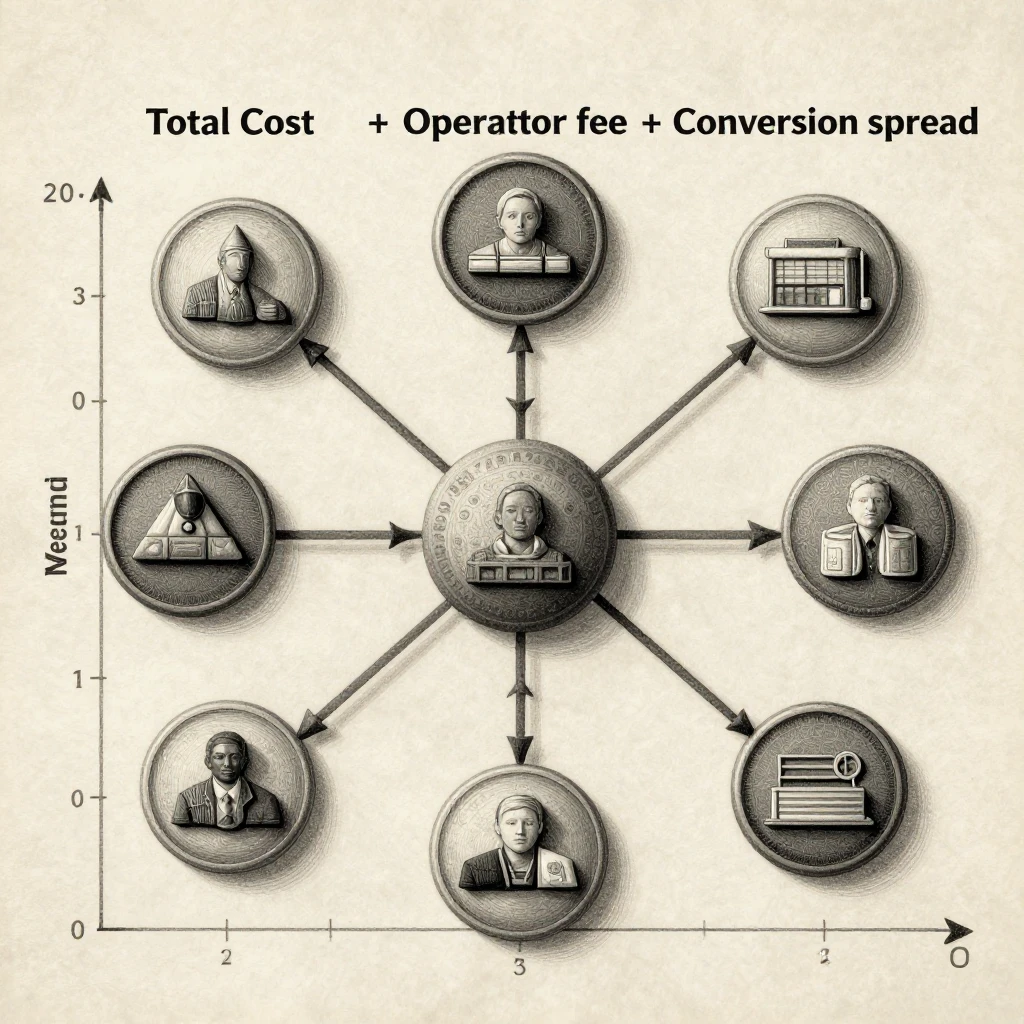
Nearly every crypto casino advertises 'zero fees.' Almost none of them mean it. The honest way to think about it: total cost = network fee + operator fee + conversion spread. Network fees are your Bitcoin mining costs on deposit and withdrawal — usually small, but not when the mempool clogs. Operator fees are the casino's own withdrawal charges, often waived above a threshold, which quietly punishes small cashouts. Then there's conversion spread, the one that actually hurts.
Here's the mechanism. You deposit BTC. You play games denominated in CAD. The casino converts your Bitcoin at a rate that isn't quite the market rate, then converts back when you withdraw. Stack a 1.5–2% spread in each direction on top of network fees and a withdrawal charge, and a 'fee-free' casino can quietly cost you 3–4% of everything you cycle through. Over a few months of regular play that isn't a rounding error. It's a house edge you never agreed to.
So check whether the site prices games in CAD or in crypto, and ask support directly what rate they use.
Bonus Terms as a Hidden Fee
Bonuses are a cost when misread. A 60x wagering requirement on a $500 bonus means $30,000 of play before anything is withdrawable — and game-weighting tables mean slots might count 100% while blackjack counts 10%. Add a max-bet cap during playthrough (breach it and the bonus vanishes) plus an expiry window that quietly kills your progress, and you've got a 'gift' that costs more than it gives. Read the four numbers: wagering multiplier, max bet, game weighting, expiry.
Payout Speeds — What Withdrawal Times Really Tell You
There's a legitimate range here. On-chain Bitcoin withdrawals done properly land in under an hour. Lightning payouts can clear in minutes. A 24–72 hour 'pending' window usually isn't a blockchain problem at all — it's manual review, or occasionally a liquidity issue behind the scenes. Keep two clocks separate in your head: processing time is the casino releasing the funds; confirmation time is the network settling them. The second is largely out of anyone's hands. The first tells you everything about how the operator is run.
And the real signal isn't one fast withdrawal. Anyone can be fast once. It's consistency — the same window every time, including on a Sunday night, including when you've won something uncomfortable. That's why I always recommend a small first cashout: deposit modestly, play a little, withdraw $50 immediately. You'll learn more from that one test than from any review page on the internet.
KYC and Why It Slows Everything Down
Crypto casinos increasingly require ID at deposit thresholds, and that's reasonable. The trap is timing. Verification before deposit beats verification at withdrawal every single time, because an unverified account is exactly how you end up in that classic 'your funds are held pending review' scenario — sometimes for weeks. Submit your documents early, confirm what limits apply to unverified versus verified accounts, and understand that a site with no KYC at all usually isn't being generous. It's just not complying with anything.
Comparing the Best Bitcoin Casino Shortlists for Canadians
Once you've filtered on licensing, fees, and payout speed, most players end up with two or three realistic options. That's the whole point of the method — it shrinks the field fast. What a proper comparison page should disclose is specific: the licence number and regulator, an average payout time with the measurement method, the full fee schedule including network and conversion, whether CAD games are actually supported, and any complaint history. Vague 'fast payouts' and 'top licensed' language tells you nothing.
A curated starting point for evaluating best bitcoin casino options can genuinely save you an afternoon of tab-hopping, and I'd rather you start somewhere organised than start at random. Just treat any list as a first pass, not a verdict — verify each claim against the operator's own terms and, crucially, against the regulator's public register yourself. Comparisons go stale. A page written in good faith six months ago can still point you at a brand that's since changed hands.
Your own five minutes of checking beats anyone's shortlist.
Red Flags and Common Mistakes Canadian Players Make
On the operator side, the pattern is fairly consistent:
- Guaranteed-win or 'can't lose' claims of any kind
- No visible licence number anywhere in the footer
- Withdrawal limits buried deep in the T&Cs rather than stated plainly
- Bonuses requiring 60x wagering or more
- No live chat, or chat that can't answer a licensing question
- 'Provably fair' claimed with no way to verify the hashes
- Pressure to deposit through a third-party wallet or an unknown address
- A design that mirrors a known brand almost exactly — usually a clone
Player-side mistakes cost just as much. Skipping the T&Cs is the big one. Testing a new site with a large first deposit is the second — you've handed over leverage before you've learned anything. And ignoring currency conversion is the quiet third, because it doesn't feel like a loss; it just slowly becomes one.
A 10-Point Pre-Deposit Checklist
- Licence verified on the regulator's own public register
- Restricted-territory clause checked in the T&Cs
- Withdrawal fee confirmed, including any threshold for waiving it
- Average payout time reviewed, not just the best-case claim
- KYC policy understood, documents ready to submit early
- Bonus wagering, max bet, game weighting, and expiry all read
- CAD support confirmed, or conversion spread understood
- Support channel tested with a real question
- Responsible-gambling tools present — deposit limits, cool-off, self-exclusion
- First withdrawal tested small before scaling up
Conclusion
License first, fees second, payout speed third. Only after those three pass do bonuses and game library deserve a look — and by then, honestly, the decision is usually already made. In 2026 the differentiator isn't crypto novelty; every second site takes Bitcoin. It's operational transparency: who holds the licence, what the whole cost actually is, and whether the withdrawal queue behaves the same way on a quiet Tuesday and a busy Friday night.
If you're playing from Canada, set a deposit limit before your first session rather than after a bad one, treat the spend as entertainment and nothing else, and step away if it stops feeling recreational. Provincial resources like ConnexOntario and the Responsible Gambling Council exist for exactly that moment, and using them isn't an overreaction.
